NEWS 2009 – page 2
News 2009 –
page 1 | News 2009 -
page 2 | News 2009 -
page 3 | News Archive (for news from previous years)
ONE GIANT STEP FOR FISHKIND (added
The previous page in this
news section told tales of the arrival of two denizens of the sea – two
Grampuses and two Dogfish. We now
complete the tale by announcing the arrival of one (yes - just one!)
Shark. It was an interesting tradition
within British Railways that names of wagons whose role in life was engineering
on the railway itself, that such wagons would be classified with ‘fishy’ names
– formally called ‘fishkind’ names. How
this tradition started is a bit of a mystery. It’s true that the GWR had a
variety of names – Tadpole, Bloater, Crocodile, Gnat, and so on, but these were
generally for revenue-earning wagons.
Oddly, it seems that the derivation of the term ‘Toad’, famously applied
to GWR brake vans actually derived from use by the London North Eastern
Railway.
A Shark is a ballast plough
and brake van. In this day and age the
Shark is a bit of a rarity, having been largely supplanted by modern
‘On-track-plant’ like the autoballaster.
Those that remain are very run down, and wagon aficionados may like to
know that the BR Version was usually built to diagram 1/598. (The diagram 1/598 Shark also had some very
close relatives called ‘Oyster’ and ‘Cockle’). We’ve been after a ballast
plough for many years, and even seriously considered ‘liberating’ a diagram
1/598 from Llantrisant yard that had been burnt out down to the steel frame,
some years ago. As work on the extension
loomed the requirement to find a Shark became ever more pressing, and we were
fortunate to find one in very fine condition at another heritage railway at a
price we could afford. Ours pre-dated
British Railways, and was built by the Southern Railway, and even then the
design came from the South Eastern Railway, which ceased to exist as long ago
as 1923. The design may be old but its
long wheelbase makes it a very much more stable van than the BR diagram 1/598
(which was derived from the LMS design and looks as if it was based on the
pre-1923 Midland Railway vans). Our type
of Shark has not worked on BR for many years, and indeed, is very rare in
preservation. So far as we know the only other specimen is on the Kent &
East Sussex Railway, though if anyone knows differently we’d be pleased to hear
from them.
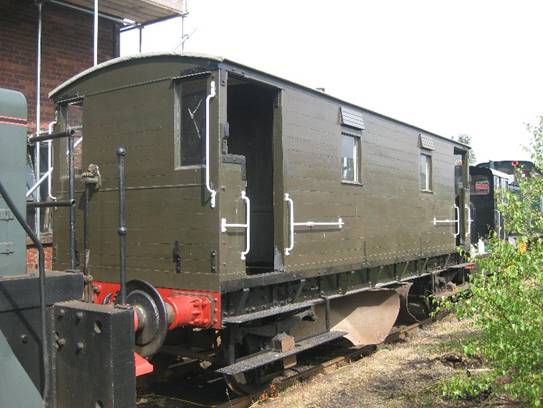
Here it is, the SR design, Shark
ballast plough, in olive-green, but as yet, unlettered. It arrived early on 25 June 2009. It is likely
to start work in two or three weeks as, aided by our Dogfish, it lays ballast on
the re-laid track down to Blaenavon High Level
DEVELOPMENT – BRIDGES COMPLETE – JUST ABOUT! (added
23 June 2009)
|
The renewal off the
bridges down the line has been, by far, the most ambitious – and expensive -
project the PBR has seen undertaken to date.
The bridges festoon the 1.75 mile route between our main station at
Furnace Sidings and our new station at Blaenavon (High Level) station. The route is to be opened to public
services on 2 April 2010. Funding
became available in April 2008, but it was many months before physical work
began, as designs were made, contractors engaged, prices negotiated, designs
torn up and designs modified. Despite
earlier assurances it was early January 2009 before contractors Griffiths of
Abergavenny started work for scheme managers Capita Symonds. This late start came at the worst possible
time for PBR as it would necessarily prevent work on the track and prevent
rail access to the station at Blaenavon (High Level), at the very time that
PBR had planned to make its biggest contribution to the overall extension
project. Not only that, but time
estimates for the necessary blockade had increased through two months to a
massive five months. The scheme
involved Bridges 13, 14, 16 and 17.
The project was originally going to include Bridge 19, but this was
deferred in the face of increasingly large cost estimates from Capita
Symonds. However, whilst the scheme
was in progress funding for the Big Pit project was announced, and with it the
opportunity to rebuild Bridge 12. With
the railway blockaded, it seemed an ideal time to make a rapid start on
Bridge 12. In the event Bridge 12
turned out to be a much more problematical bridge in engineering terms than
had been anticipated, accordingly, the bridge, instead of being completed
within the five month blockade envelope, drifted on for a further month. Details on the engineering
progress of all the bridges can be found HERE. To their credit,
contractors Griffiths effectively had their bridges finished on time, and
ready for the weekend 23 May, a week or two earlier than the five months
forecast. Meanwhile the contract to
design and rebuild Bridge 12 had been awarded to Cambrian Transport of
Gloucester on 21 January. As noted
earlier, this bridge threw up unexpected challenges and it will be the
weekend 27 June before work is effectively completed. The completion of the
bridges means the blockade can be lifted and PBR can get down and relay the
rails over the bridges, complete the track replacement programme, and finally
relieve the abandoned souls who have been working away at Blaenavon (High
Level) station, unsupported by rail, since early January. There is still some detailed work to do on
the bridges, but with the logjam finally removed PBR’s frustration will be at
an end, and their volunteers will be working flat out to complete the
extension work by the end of 2009. But
there is no respite – there is then the Big Pit project with which to contend! |
|

DEVELOPMENT – FUNDING FOR BIG PIT BRANCH ANNOUNCED
(added 4 May 2009)
The 16 April was an
important day for railway, when the Company formally heard that funds were to
be made available. Go direct to HERE
for the story.
DEVELOPMENT – BRIDGES REACH CRITICAL PROGRESS STAGE
(added 10 April 2009)
The long and expensive job
of repairing the four bridges along the route of the extension has reached a
critical stage with the new support beams on the difficult Bridge 13 going in. Good progress has been made with bridges 17
and 15 complete, and with bridge 14 expected complete within a week or two we
are confident that access down the line ill be possible again in late May. See updated report on Bridge 13 in our
‘Development’ section
A DEDICATED NEW LOCO (added 30 March 2009)
|
|
Unlike the recent rash of
immigrants to the PBR this loco was purchased by the Company for a very
specific role – to work the Big Pit branch. Work on the building the
branch starts formally on Wednesday 1 April now that funding is in place,
with opening due in April 2011 – a year after the extension to Blaenavon
(High Level) opens. Funding for a
dedicated loco had been agreed, and the fact that the loco, currently named
‘Bill Caddick’ should come to market at just the right time and at the right
price ensured a ready sale. In fact
‘Bill Caddick’ was another casualty of the sad situation that has engulfed
the volunteers at the Barry Island Railway, so its purchase was tinged with
rather mixed-feelings. At 205hp it is an ideal
loco for the branch – small wheeled and powerful, without being unnecessarily
quick, and with combination loco-air and train-vacuum brakes. It is planned that it will work short
‘colliers –trains’, which will consist of open wagons when the weather is not
too wet. The loco was built by
Hudswell Clarke as D1126. In 1985 it
was returned to Hunslet for a major rebuild and emerged in 1986, with new
works number D8526 and re-engined with a six-cyliner Gardner engine. Full
technical details of this loco will appear in our loco register shortly. Also purchased from Barry
were a six-lever lever frame and a water-tower, which we hope will be
installed before Summer 2010. Left: Bill Caddick ‘touched down’ in the yard at 1230
Wednesday 26 March after the short journey from Barry on the back of John Antell’s
lorry. Here is the loco, returned to
the yard after a very brief test run. Img_2151rr.jpg |

YET ANOTHER NEW ARRIVAL (added 30 March 2009)
This privately owned and rather
‘down at heel’ specimen was delivered in early March to take up duties as a
mobile store. It was built as a General Utility Van or GUV. GUVs certainly were very useful vehicles, and
the ends were fitted with opening doors, designed so that the lower section
would drop down over the buffers. When
coupled together as a train, cars could load at one end and drive down the
entire length of the train before being secured in readiness for the journey. Nowadays used mainly as parcels vans, this
specimen is fitted with modern ‘Commonwealth’ bogies, and has suffered the
indignity of having the door windows plated over to prevent attack by vandals
and thieves. We are told that the
vehicle is to receive a re-paint very shortly
|
Right: In an ‘interesting’ livery of RES and
rust, set off by a nicely peeling roof GUV number 95136, TOPS coded NOX, waits in the delivery road, shortly after
being dropped off. img_2111rrc |
|

PANNIER TANK VISIT ANNOUNCED (added 1 March 2009)
In September we
celebrate the 140th anniversary of the first trains to run on the line (see
‘Events Diary’). We are pleased to
announce that pannier tank No.6435, from the Bodmin and Wenford Railway in
Cornwall, will be visiting us on 12th and 13th September to join in the
celebrations. The loco will also be
performing photocharter work on the following Monday, 14th
September. For details of our
photocharter, return to the front page, and follow the link in the ‘Photocharter’
banner.
NEW ARRIVALS (added
It almost seems these days
that the ‘quiet’ months of January and February seem to herald an annual influx
of new stock. We started early in 2009 –
very early – since it was way back in late November 2008. In the Christmas rush we clean forgot to
record it, and it was ‘Vanguard’ that started the ball rolling. January saw the arrival of ‘Trecatty’, and
this was followed up with Tourist Second Open (TSO) Sc4300 from Barry.
|
Here is ‘Vanguard’ pictured on 30 November
2008. ‘Vanguard’ is a 4-coupled chain
driven loco. It is privately owned,
but with its air-brakes, it may be useful for shunting our DEMU and EMU
coaches around. img_1654rr |
This is ‘Trecatty’, which worked in an opencast
site of the same name near Cwmbargoed for Taylor Woodrow. This is an 0-6-0 DM built by Ruston
Hornsby, and spent some time on the Gwili Railway img_1922rr |
This is the new coach which was purchased from the
Barry Island Railway. This is the
‘people carrier’ of the Mark 1 series – the Tourist Second Open or TSO. It can carry 64 seated passengers and is
numbered Sc4300, having been allocated to the Scottish Region img_1867rr |


News 2009 –
page 1 | News 2009 -
page 2 | News 2009 -
page 3 | News Archive (for news from previous years)
