DEVELOPMENT – FURNACE SIDINGS-FOOTBRIDGE (STEP 1.3.2) – Page 1


Click HERE to go directly to page 2


The ‘Hinckley’ footbridge (uploaded 24 October 2008)

There seems to be poplar misconception amongst visitors that all preserved railways in Wales and the West must be Great Western.  In the case of the PBR, this is certainly not true.  Our history section will show that the part of the line between the Whistle Inn, through Furnace Sidings down to Blaenavon (High Level) was built by the Brynmawr and Blaenavon Railway in 1866.  In reality the B&BRly was really the all-powerful London & North Western Railway (LNWR) in sheep’s clothing.  In 1923, at the grouping imposed by the government of the day, the LNWR became a constituent of the mighty London Midland and Scottish Railway (LMS), and so it remained until nationalisation produced British Railways in 1948.  It is true that the line was worked by GWR engines in later days, but retained LNWR and LMS signals to the end.  However, the inescapable fact was that it’s infrastructure, such of it that remained until later days was pure LNWR.  Now although Furnace Sidings never even existed as a station prior to preservation, we felt honour bound to at least make it suggestive of an LNWR backwater.


When the notion of a second platform and a linking footbridge was being considered, it was with LNWR ‘furniture’ in mind.  It was a pure stroke of good fortune that round about this time we became aware of a genuine LNWR footbridge in store at the Rushden Historical Transport Society in Northampton, and that they wanted to dispose of it.  A visit to Northampton on a sunny day in October 2006 revealed a beautiful station building, both inside and out, and an impressive LMS signal box, but the footbridge had caused them problems.  It was poor when they acquired it fifteen years previously, and after all that time in outside storage, it had suffered grievously.


The main deck is on the left, and the two towers, one threaded in the other lie on their sides on the right.  On the main deck the bottom angle had rotted beyond redemption, and the side plates were holed in a number of places.  Behind can be seen the typical LMS signal cabin


Member Alastair Warrington stands close to the top of one of the towers.  The cast trusses were in good condition, and retained a certain ‘heavyweight’ LNWR charm.  The legs had not only been burnt off, close to their bases, but had suffered very severe corrosion

There were some interesting details, as the cast supports for the handrail on the stair portion of the main deck illustrate 


Some of the side walls would need complete reconstruction.  The presence of soil and weeds within the structure served only to accelerate corrosion

The stair flight side walls were in generally very poor condition, and this photo shows the bottom of the heavy cast newel post.  The base of this post is in good condition, but several had pieces cracked or missing at the base

Oh, for a station waiting room like this one.  Now used as a member’s bar in the main building.


By the time we got the main deck to Furnace Sidings on a rotten wet day in early November, our enthusiasm for this bridge had been tempered by thoughts of ‘What on earth have we let ourselves in for?’, and our confidence started to wane.

The delicate job of offloading the main deck off the lorry onto terra firma was undertaken by a second lorry fitted with a hi-ab unit.


Volunteer and ace welder Derek considers how he is going to put the rest of tower 1 together


-and here is the completed tower.  Getting it upright safely proved to be a difficult job

A detail showing the stair flight bracket and the heavy cast spandrel that supports the main deck


On 27 August 2008 was a day of typical low cloud, as the local transport firm was called in once again to move the tower onto the platform.

It was a tricky job with the lorry reversing up the grade, and often slipping – and it’s always worse when someone’s watching.

Finally, with the hi-ab at absolutely full stretch, the tower was dropped to within an inch of its final position.


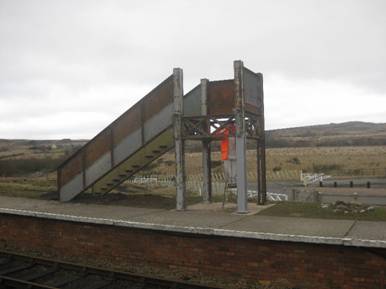
Looking strangely isolated we see the tower on the rather barren platform 1 in this view looking north east

Viewed straight on, the tower appears to lean, with the platform straight.  In fact it is the platform that is not level- the tower is dead plumb

A week later on 7 September, it’s Derek once again who grouts the tower into its concrete base with resin anchor bolts to make sure it stays put!


News on the ‘Hinckley’ footbridge (uploaded 15 April 2009)

The winter has seen a lull in the proceedings since Derek was involved fixing the loco shed roof which had blown off during the winter gales, and it was far too cold and damp to attempt to paint the footbridge, but eventually Spring 2009 arrived and work resumed.


In mid-February the repaired stair flight walls arrive on Platform 1.  The flower bed under the posts of the running-in board posts would be an early casualty

img_2022rr

The first flight wall went in without too much of a fight,  a few days later - but it was the Manitou’s jumbo tyres which laid waste to the flower bed.

img_2028rr

Both flight walls are on but there is a definite twist on the left hand wall, we suspect due to poor storage conditions at Rushden

img_2037rr


With the weather a little warmer and days slightly longer, the laborious business of chipping away old paint gets underway, as volunteer Bev W attacks the tower with a variety of dangerous looking implements


Img_2038rr

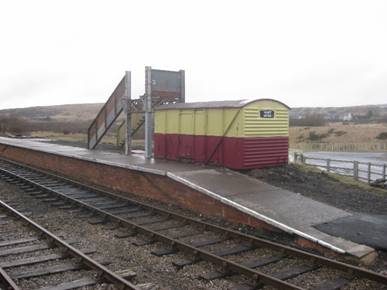
Not really related to the footbridge, but we knew that we were going to have to move the old ‘station building’ (an old banana van) before construction of its replacement could begin.  We planned to do this late in 2009.  The chance arrival of a crane on site doing something quite different decided a rapid re-deployment on Platform 1 as the van was moved south of the bridge, where it teeters on the south end of the platform.

img_2090rr

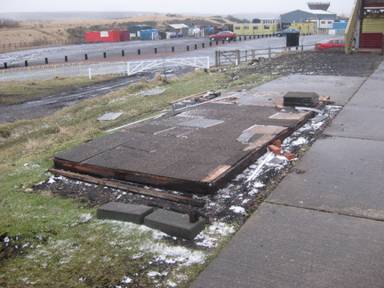
Not all our plans are trouble free in the execution.  In this case the van was lifted – and left its floor behind.  A pity this, as we now have even more work if we are to restore the van.  It’s worth doing, as there are only one or two in preservation, and the sight of one, with its characteristic yellow spot would make a colourful addition to our demonstration freight train


Img_2088.


In early April, the newel posts were fixed to the bottom ends of the flight walls and concreted into position. Straining bars had to be employed to force the twisted flight wall back into shape, whilst the concrete set.  A few days later the bars were removed and, thank goodness, the flight walls remained perfectly aligned.  Here volunteer Eric (he of Eric’s Emporium’) examines the work, whilst Derek looks on, having just welded the ‘Furnace Sidings’ sign permanently into position.

img_2187rr

Its Easter Sunday and a fine Spring morning sees platform 1 well patronised as passengers wait for the first train.  In the background, the tower, topped by ‘Y Ddraig Goch’ has been fully primed, including the newel posts.  A new coat of undercoat/topcoat is being applied now, which will bring the bridge a shade darker.


img_2280rr


So that is the current situation.  We still have to install the cleats, which support the footsteps, and we are having new brackets cast which will support new handrails.  It is expected that the timber for the footsteps and decking will be ordered very shortly and these must be installed.  Since many of the timbers will have profiled ends in order to provide clearance for bolt heads and other bits and pieces this could prove to be quite time-consuming, and it is recommended that this work is completed before the main deck is finally lifted into position.


Click HERE to continue to page 2


Click HERE to return to Main Development page