DEVELOPMENT – FURNACE SIDINGS PLATFORM TWO (STEP 1.3.1) –
Page 1
Furnace Sidings, Platform 2 – Page 1 (added 23
October 2008)
There had been a growing need
for a second platform at Furnace Sidings for several years. The need for a second platform stemmed from
both an immediate requirement for gala events, where traffic density demanded
such a platform, and a longer term need to meet the demands arising from
requirements of extending the railway to Blaenavon, and possibly to Big
Pit. In the early days, before a
signalling system is installed and assuming that we are running more than one
train, then the second platform (Platform 2) will provide a terminus for trains
from Blaenavon or Big Pit, whilst the existing platform (Platform 1) will
provide a terminus, as it does now, for trains from Whistle Inn. We have also discovered that having a second platform
is very useful for working on carriage stock! In Autumn 2006 surveys
were made and plans drawn up. The
Company board authorised the construction of such a platform in December 2006,
subject to the necessary consents being obtained. The Railway Inspectorate raised no objection
to the work proceeding, and, although planning consent was unnecessary, TCBC
Planning Control was advised. Physical
work started on 24 July 2007, and within thirteen months, by Tuesday 26 August 2008
to be precise, the platform was ‘functionally complete’. There is much detail work left to do, most of
the work is cosmetic and can be left to catch up, though the extension work to
Blaenavon (High Level) must take priority
The length of the platform
was constrained by a watercourse at the north end and the crossing at the south
end. It may be possible to build over
the watercourse in the future, but a brief cost benefit analysis indicated that
such work was best left at this stage.
The platform is shown in plan in the figure below. It is 50m long on its top surface and 2.5m
wide with a top made from concrete slabs in like manner to platform 1. If another 7.5m at each end is added for the
ramps the total length is 65m . This is easily long enough for two coaches
and a small loco. The berthing of three
coaches in a loco hauled formation is not expected to become routine for a
number of years, and when it does the situation will need to be re-examined,
although, with suitable conditions, we can just about accommodate such trains
if conditions are imposed. The current
plan leads to a slightly staggered layout, which is quite attractive.
The design is made difficult
since it lies on the slope of Coity Mountain from
which great volumes of water cascade in wet weather. In the case of Platform 1 water continues to
flow downhill from the front wall, but on Platform 2 the front wall forms a
potential dam to such flows, which ultimately cause heave and failure and collapse
of the concrete slabs above. The design
thus calls for extensive drains which route most of the water to a culvert to
the south of the platform, though some is arranged to flow to the troublesome
culvert at the north end.
The image and the notes below
it, came from the original document approved by the
board
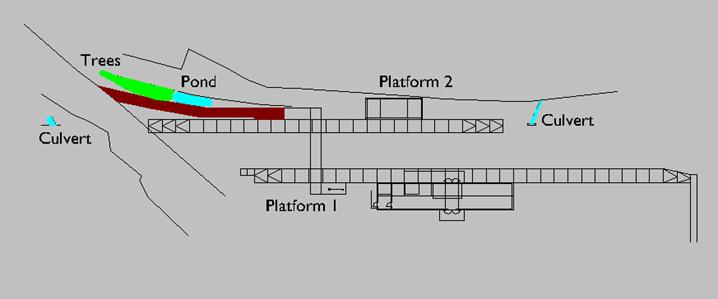
Notes:
·
The image shows the crossing on the left hand side with platform 1
at the bottom and platform 2 at the top
·
The disposition of the crossing is drawn from out-of-date data,
and therefore does not accurately reflect the current situation.
·
The representation of the platform 1 building does not properly
describe the wall thickness
·
In all remaining matters a high degree of accuracy has been
achieved.
·
Platform 2 is shown in its final form with a 50m top surface and a
7.5m ramp at each end. The ramps are
notably shallower than those on platform 1
·
The proposed platform building is shown at a nominal 3.5m x 10m
plus wall thickness. This is the largest proposed size. A smaller building may be preferable. The building is shown without a canopy,
though this can be provided if the size of the building demands such a fitment
for the purpose of aesthetic balance. At
this stage it has not been decided whether a ridge or monopitch
roof should be fitted.
·
As shown the building is close to the boundary fence shown at the
top of the drawing. The kink in the
fence is believed to stem from the original 1866 design of the railway
·
The existing trees are to be husbanded in order to assist the
growth of sound silver birch while discouraging further willow growth.
·
Water has collected at the position shown ‘pond’ for many
years. This area is to be deepened and
fitted with a weir in order to control its level, with outflow directed to the
existing drainage system, in order to provide a natural feature. The proposal to preserve the pond and trees
has met with approval from TCBC
·
The bridge is shown accurately in its final position. Access to both bridge and platform 2 will be
via the path marked in brown and which will appear dark in monochrome. Passenger access via the ramp will be
discouraged. The levelling relationship
between the path and the platform is expected to be complex, partly due to the
unequal flight lengths of the footbridge, and fences will be needed to properly
segregate the various levels. The
outcome should be visually interesting.
This work was without doubt
our largest self-build, self-funded project to-date. The following facts and figures may be of
interest:
- Overall length 65m
- Length of top surface 50m
- Backfill – about 350 cu yds
- Foundation 12.7 m2 mass concrete
- Blocks for main wall - 1408
- Bricks for front leaf of wall 3902 (2700 new,
balance second hand)
- Weldmesh reinforcing 217 m2
- Slabs on top surface and ramps 26, each of 2.5m2
(16.25m3 reinforced concrete).
Physical work started on 24
July 2007 and was completed on 26 August 2008 – 398 days later.
The story is told below in
pictures:


|
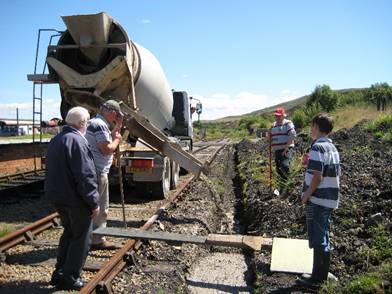
Physical work
began on the Tuesday evening 24 July 2007 when Jonathan Goss started the
northern end of the foundation trench.
It is pictured mid-afternoon the following day |
Wednesday
and Friday saw the job almost complete.
However, at the southern end, it was known that the pipe from a small
reservoir fed in turn by the ‘mile pond’ (which is actually only a little
more than a quarter mile long), passes just below the surface to supply our
yard. Fracture of this pipe could have
emptied the reservoir and even if only a quarter of a mile long, still
contains enough water to wash away much of the railway! |
Fortunately
we missed the pipe and on Tue 31 July and Wed 1 August the 65m long trench
was filled with concrete. Here (l to
r) is Eric Edwards, Norman Clymer, Peter Drummond
and ‘gopher’ Billy with the hi-tech PBR patent foundation depth gauge! |
057 25 Jul, 063 28 Jul, scan004 -31 Jul


|
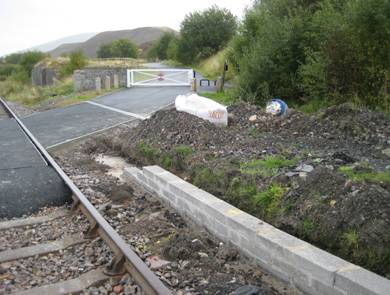
As soon as the footings were dry and the concrete
blocks delivered, a start was made at the south end. The design called for the blocks to be laid
‘side-down’ in order to produce a wall of sufficient thickness. The first few courses were back breaking,
but the first 43 had been laid by 21 August, and by the time this photo was
taken on 27 August the total had reached 196.
Wayne Evans and his family are seen in the distance. |
A few weeks
later, on 19 Septembe, the block wall, now three courses
high, stretches essentially from end to end.
Subsequent laying is a little easier on the
back now– but not much! |
Uncertainty
at the absolute south end caused some delay since the foundation concrete was
slightly high here, so that special arrangements has
subsequently to be made. |
img0300 27 Aug,
0389 19 Sep, 0418 19 Sep


|
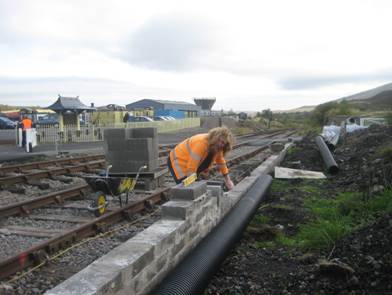
Complications
at the south end, looking north |
It goes
without saying that a straight platform needs to be straight, however the
overall length was way beyond what could be set with either string lines or
lasers. Alignment was set by optically
aligning a series of pyramidal ‘monuments’. |
For no
particular reason, Ian concentrated on the south end and Wayne at the
north. Here Ian works towards one of
the full height monuments. Pipes ready
to form the land drain can also to be seen. |
0419 19 Sep, 0512 – 1 Oct, 0520 –
1 Oct


|
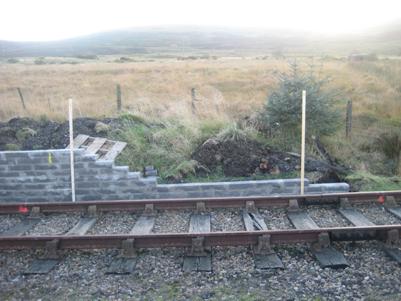
By 1 October it was clear that there was no
stopping the team - here we look north
|
...and here
is the view looking southwards. |
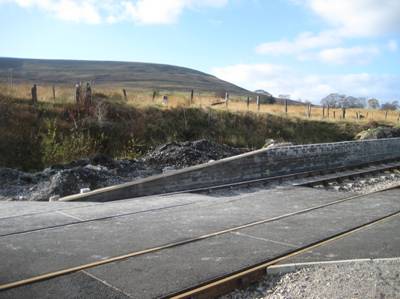
Care had to
be taken at the ramps to avoid unnecessary work. Here is the north end on 18 October |
0521 1 Oct, 0522 1 Oct, 0605 18
Oct


|
A month later, on 31 October the block-laying was
all but done – looking north again |
...and now
south. What a difference a month can
make! |
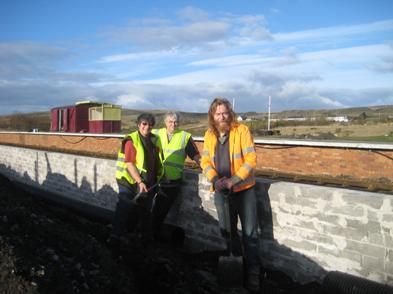
A wwel later, on 6 November, the end ramps had been sculpted
to the correct shape |
0622 31 Oct, 0623 31 Oct, 0632 6 Nov


|
A general view looking north at the completed
block wall shows the relative positions of the two platforms |
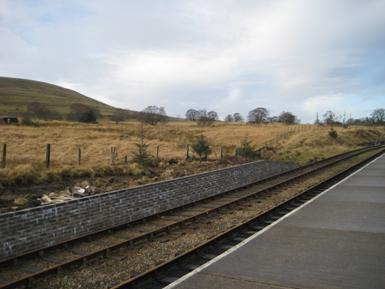
Here’s Wayne
and Ian – heroes of the piece, back wall completed, land drain in, on 11
November |
And here’s
the crew again, accompanied by Frieda, Wayne’s wife, who has ably
demonstrated that despite an ecclesiastical role Mondays to Fridays (and some
Sundays) she no slouch on the spade. |
634 6 Nov, 636 11 Nov, 637 11 Nov


|
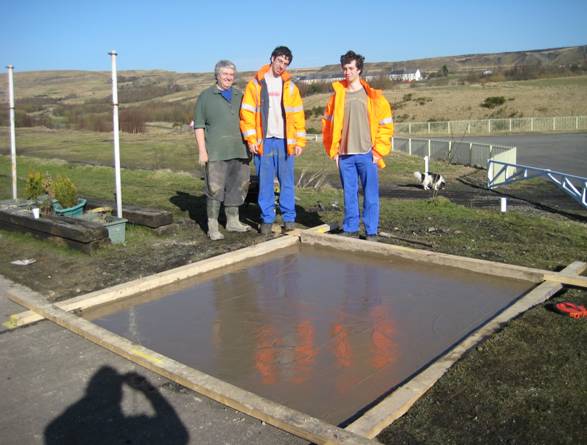
On 16 December , a Santa
Special waits for the off. Behind the
wall the land drain lies partly buried us the volume of backfill starts to
increase |
Into the New
Year, with a detailed shot of the wall, now at full height, on 9 January
2008. A cold winter sun does little to
raise either temperatures or spirits |
One the
same day, the cold winter stillness pervades everything is we look at the
north end. |
718 16 Dec, 776, 777 9 Jan 08

|
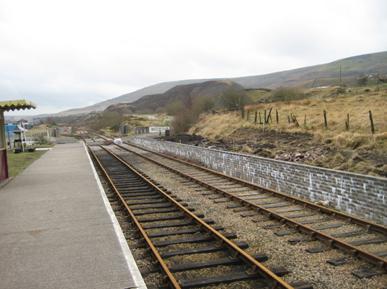
As an
aside, we turn to Platform 1, on 12 February where the mass concrete base was
being poured in readiness for its role as the base for one of the towers of
the footbridge. The ubiquitous Wayne and
Ian at it again. Wayne and Ian at it
again. |
The
situation is made complex by the need to have a level base on a platform that
slopes down southwards at 1 in 40.
Wayne and sons Matthew and David, who are increasingly immersing
themselves in the hard business of bricks and mortar – and wet cement! |
842 12 Feb,
845 12 Feb


|
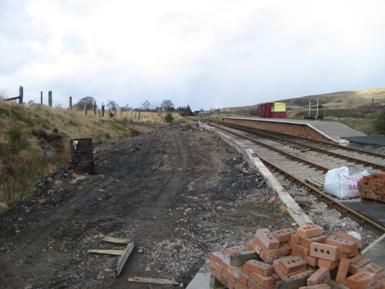
Viewed northwards from south of the rebuilt level
crossing |
A bit
further up we see that the first courses of bricks have been laid... |
...and here
we are, looking back. The first1200 or
so bricks were second hand, which led to difficulties in laying them
vertically and in keeping the ’perps’ aligned. |
897, 898, 903, 25 FEB


|
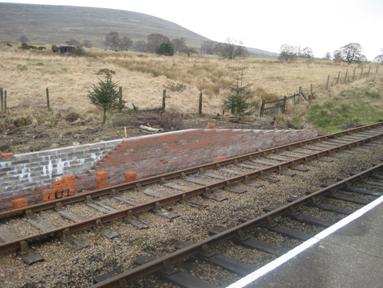
Viewed
northwards across the rebuilt crossing from the south |
Behind the
platform the volume of backfill is now increasing rapidly |
We tried to
keep things looking reasonably tidy, but at times things looked more like a
building site |
979
3
Mar, 980, 983


|
Bricks
start to appear at the north end... |
...the
bottom few courses are in |
...and a
fortnight later reach the top at the northern end |
1076, 1077
2 Apr, 1110 17 Apr

|
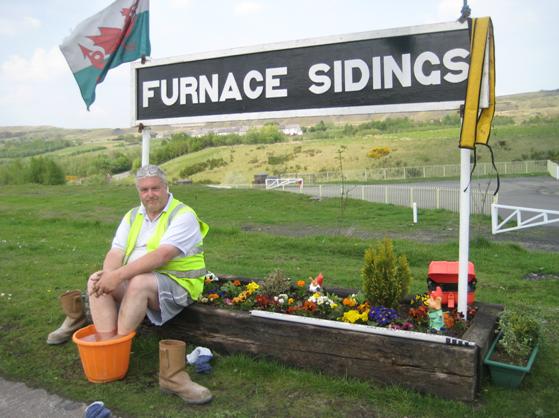
Ooh– but
it’s hard on the feet. Wayne applies
some coolth after a warm day in May |
1204/5 11 May
Click
HERE to move on to Page 2
Click
HERE to return to Main Development page