DEVELOPMENT – BRIDGE 19 (Step 1.2.4.6)
Bridge
19 (uploaded
Bridge 19 is the so-called ‘
It is just south of Blaenavon (High Level) station,
and it had been intended that it be included as part of the original Step 1.2
bid, but the increasing costs of repairing it has forced it onto the
‘back-burner’ earlier this year. Since
then, attempts to get the work funded have appeared promising, only to fade
away almost as soon as they appeared.
The bridge is not essential for simple multiple-unit operation, but will
become an increasing problem as locomotive hauled trains become the norm, and
is of course is an absolute requirement if Phase 2 and Phase 3 – extension to
Varteg and Talywain, are to be realised, and, of course Phase 6 – extension
towards Pontypool. Verily is the
strength of a chain the strength of its weakest link.
|
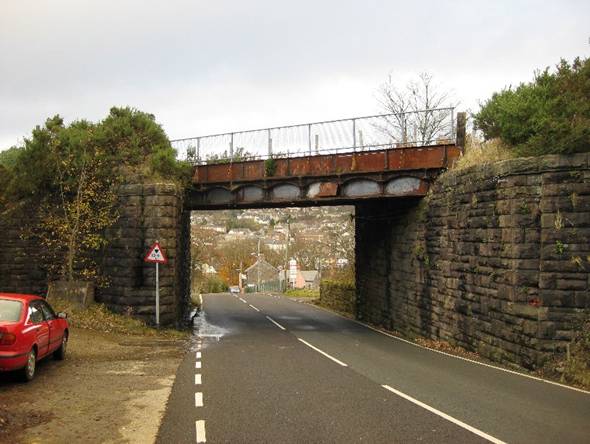
Looking
broadly east down the hill into Blaenavon.
The bridge is of only 13ft 9in clearance. As a result of careless lorry drivers, it
has seen a few wallops over the years, as can be seen on the third arch from
the right where a plate has sprung.
Sadly this seems to be happening with increasing in frequency. The
mesh fence on the parapet is an addition introduced within the last five
years to safeguard walkers and cyclists. |
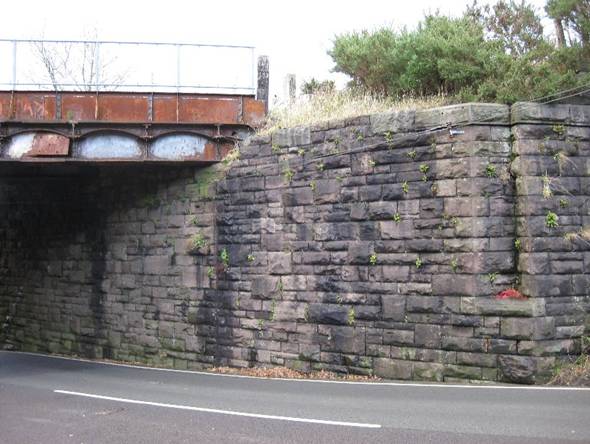
The
abutments are of massive cut stones, are remarkably intact and the
workmanship is worthy of close inspection.
The bridge is, or rather was, quite complex. Originally it had four longitudinals,
effectively supporting three decks, the third deck, nearest the camera, was
removed some years ago, but, more oddly, it sloped up to the right as can be
seen by the uneven height of the abutment.
The line on this deck led on up a horrifyingly steep gradient to the
so-called ‘Varteg Hill Colliery’ |
|
Here the |
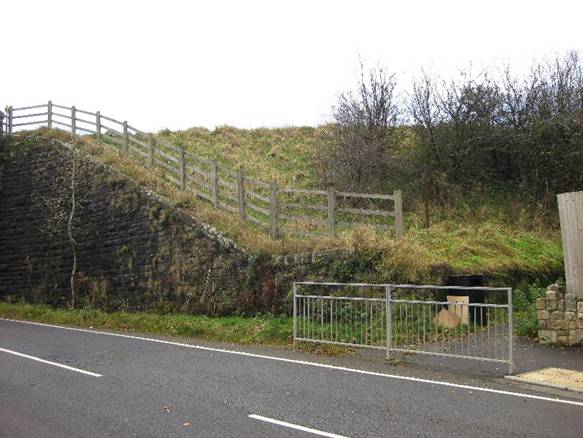
The
entrance to Blaenavon High Level station (by the fence) is somewhat
unprepossessing, and will need careful treatment if it is to become a fitting
entrance.. Nevertheless it forms not
only the only access to the station, but the only access to the cycleway from
this part of town. Unfortunately the
main road to the station, on the other side of the bridge, is now in private
hands, and it seems unlikely that the railway will be able to use it in the
foreseeable future. |
|
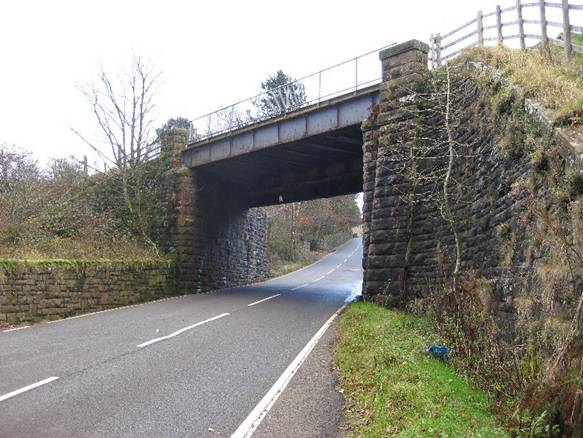
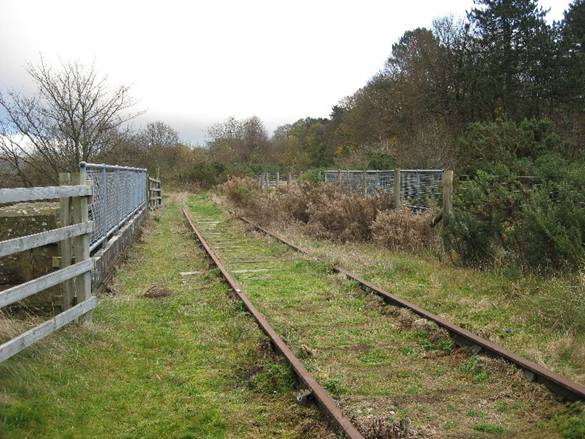
Viewed from
above, the route southwards is all but impassable – as indeed was the route to
the north until our volunteers set to work a year or two back. There is a further 400 yards or so of rail
south of this point. The cycletrack is
on the right, but is rather indistinct due to growth of gorse and other
vegetation. |
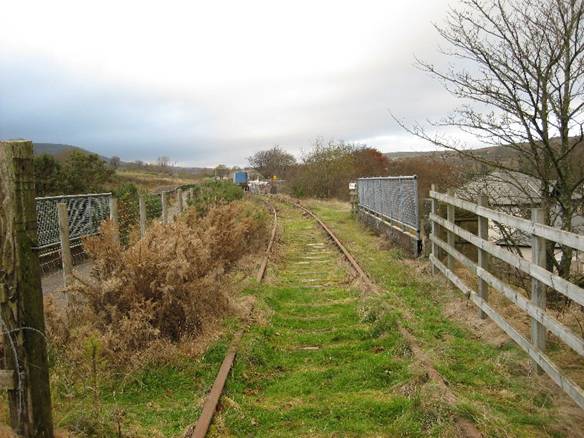
Viewed to
the north the ‘works train, is stored in the platform, which is rapidly
emerging from years of neglect, and which will be essentially complete by
April 2009. In this view the cyclepath
is easier to see, and effectively, makes use of the middle deck of the
bridge. In days gone by, three lines
of rails occupied the bridge |
Update
(uploaded
Capita Symonds were awarded a design contract in
January to design a replacement bridge for the
·
The new deck will be made of steel and will retain as many of the visual
heritage features as is possible
·
The new bridge is required to have increased headroom
·
The cycletrack will be carried on a separate bridge, probably aligned
close to the original Cemetery Branch line
·
The designers have been asked to look at the feasibility of carrying two
lines of rails across the bridge
A word of history is perhaps needed here – although
the route both north and south from the bridge was single track, there was
additionally, in effect, a passing loop over the bridge which formed a second
line of rails. From the loop a third
line of rails which crossed the original bridge on a separate part of the deck
(see second photo above) climbed westwards at the south end, past the cemetery
and then on a very steep gradient to pass over the Varteg Road on the so-called
Ash Tree bridge before climbing on up to Varteg Hill colliery. All but the
faintest traces of the cemetery branch have long gone.
Apart from the design work TCBC are seeking funding,
possibly from HoV, to see the bridge renewed in the next one or two years. Such an event opens the possibility of
further southward expansion to Varteg (Phase 2) and beyond. At present, though, it is not possible to
advance more than about 400m before coming into conflict with the cycleway. Even this short extension would allow for
useful berthing facilities for terminating trains, apart from providing an
obvious visual presence by working regularly over the bridge.
Update
(uploaded
Not unexpectedly, since formally, physical work
started only yesterday, not too much to report.
However, believe us, things will happen quite quickly over the next few
weeks. As previously reported, the
design authority is Capita Symonds, the main contractors are Griffiths of
Abergavenny, and the bridge is being constructed by a well-known firm of
Blaenavon engineers and fabricators.
This latter makes the job much easier to execute and we are confident
that progress will be rapid.
|
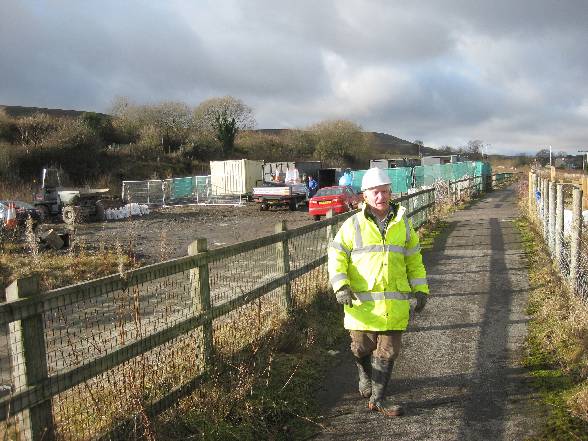
The immediate requirement for any job of this size, is that the requirements of the workforce are satisfied, and here a sizeable collection of portacabins and the wherewithal to support it has appeared almost overnight. Here we look north, with Blaenavon (High Level) station to the right of the fence and private land to the left. It is fortunate that such land just happened to be there, otherwise life would have been difficult. Foreman Bob of Griffiths who oversaw the installation of Bridges 13 and 14 with casual ease, born of years of experience strides purposefully towards the camera. 7883 – 11 Jan 2011 |
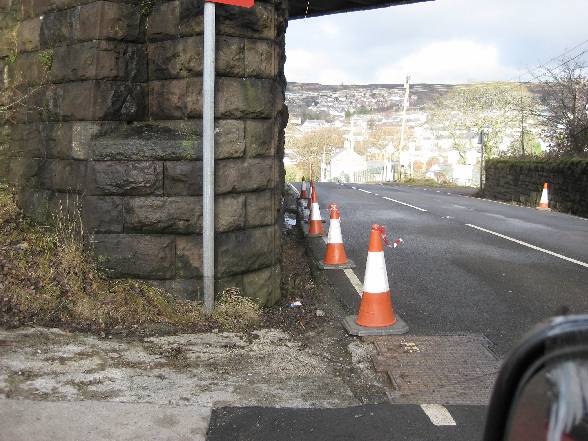
Hardly
the most inspiring shots, but here, looking under the bridge, down into
Blaenavon, we see the work so far – two files of cones, one in each
gutter. We imagine that this is the
precursor to work on the top of the abutments. 7883 – 11 Jan 2011 |
They
came, they saw, they went away again… (uploaded
Saturday 22 January dawned cold with frozen ground,
rather cloudy and with occasional burst of sunshine. Preparatory work by Messrs Griffiths was all
but complete to allow G.O.S Engineering (the ‘well-known firm of Blaenavon
engineers and fabricators’ mentioned in our previous update) to lift the deck,
aided by their contractors Baldwins Crane Hire.
It was all going to be so easy.
The pictures below and brief captions tell the tale...
|
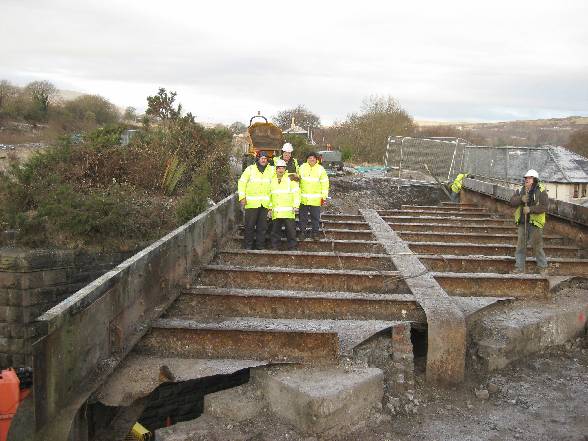
Here ,looking north, we see the deck
completely de-vegetated. It’s worth
comparing this image with the third image on this page. The railway on the right has gone, along
with the cycle track previously on the left.
Left of centre a group of jolly GOS Engineering employees are
determined to get themselves photographed. 7920 – |
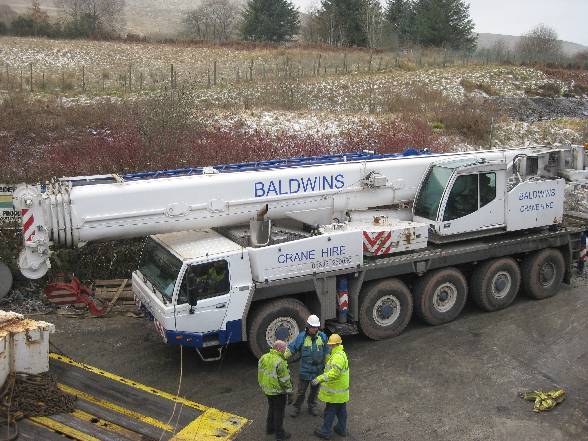
Parked temporarily up the road access
to the station the 25 ton crane is parked shortly to be moved into place
ready for action. 7922 – |
|
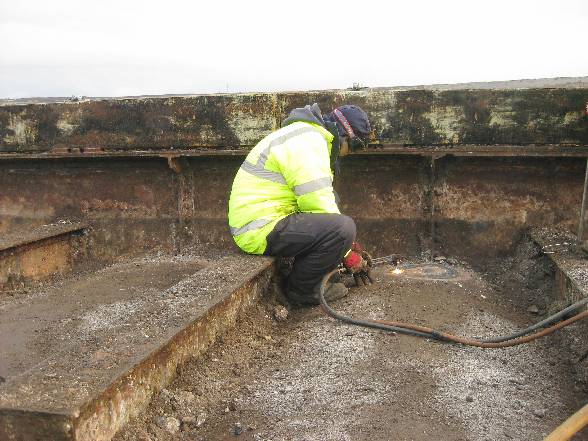
It was planned to lift the bridge
with four chains, each rated at 11 tons.
In order to provide a safe place for the chains to be shackled
underneath the deck, four holes were cut in the jack arches in readiness. It was announced that the lift would be complete
‘in twenty minutes’. 7925 – |
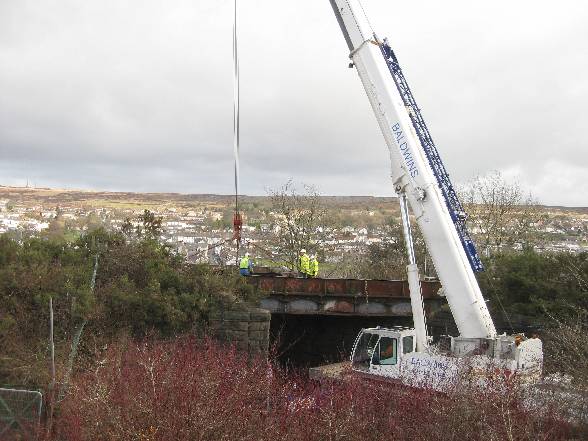
The estimate of the deck weight was
17 tons – 20 tons top whack, however, after a series of creaks and groans and
a couple of loud bangs, it soon became clear that the deck was not going to move,
with an estimated weight of possibly forty tons. 7928 – |
|
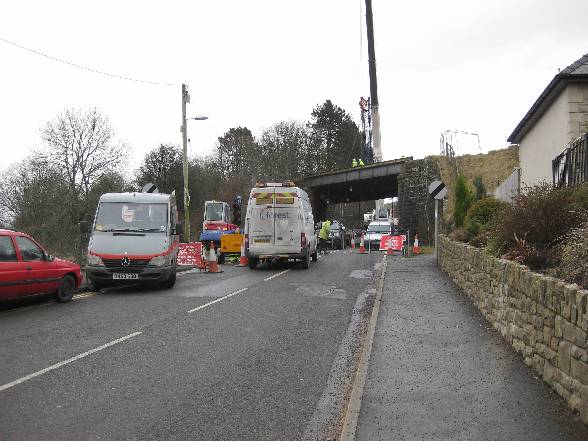
With the crane withdrawn in order to
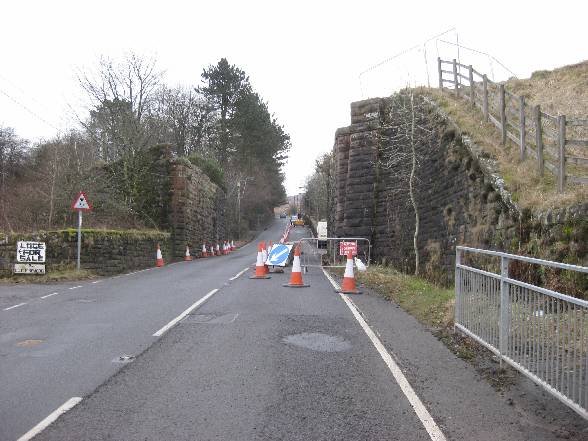
consider ‘Plan B’ there was a chance to record the bridge from the road, and
the collection of contractor’s vehicles shows how busy things were. The deck look a little bare without its
parapet fence. Traffic lights remained
in place where they had been used during the week, but during the day the
road was completely closed and the traffic lights were switched off. 7929 – |
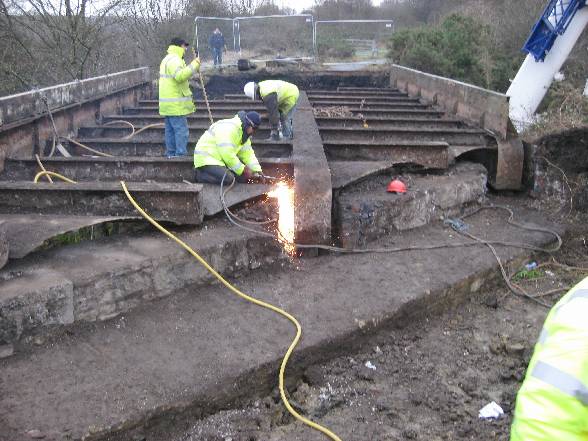
The
solution was remarkably simple – cut the bridge into longitudinal
slices. Here we see a start being made
on the north end, with the cutting which was completed in relatively short
time. The result was a bridge cut into
two slices. The weight of the section
on the left would be a little over a third of the total, which should be
simple to lift. The remaining two
thirds might yet prove difficult to lift, but in this case it would be simple
enough to slice the remainder close to the centre longitudinal. At the time when this image was taken, the
intention was to complete the lift of the three slices the following day. 7933 – |
The
following day… (uploaded
Sunday morning dawned similarly to the previous day,
with the temperature perhaps a degree or two higher. During the interim, thoughts had been
marshalled and a clear route forward was in everyone’s mind. What was to come was both symbolically important
(the severance of the line) and visually exciting, so an excess of photographs
seemed entirely justified.
|
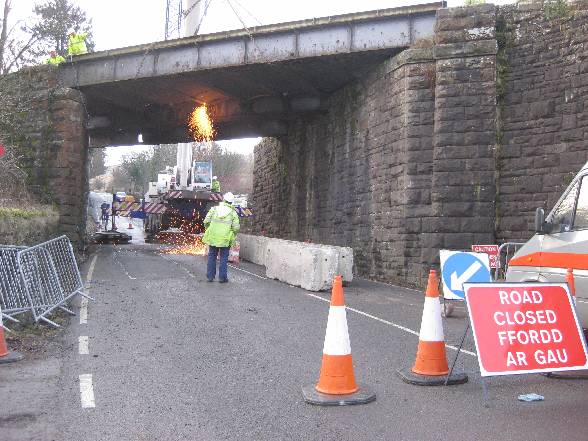
Once again
the slice of bridge was constrained by the crane slings, and the shower of
sparks from the cutting torch marks the points where the remaining ‘nibs’
(retained to maintain the slice stable overnight) were finally cut through 7936 – |
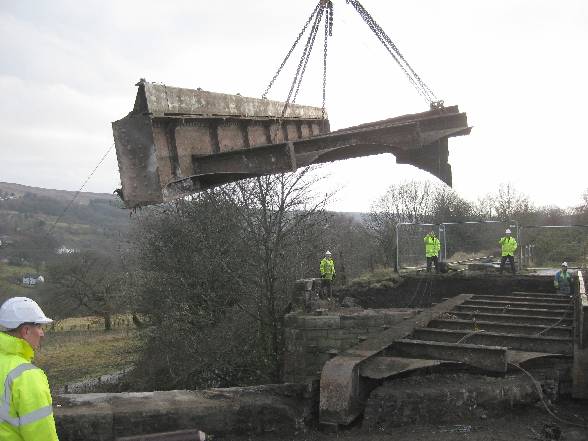
When first
pulled the end furthest from the viewer snagged but five minutes co-ordinated
work between the crane and a crowbar soon saw the eastern slice yield – and
far few jack arches and short transverse beam bent downwards. With the crane line vertical and the load
swinging freely, it was possible to accurately weigh the assembly – a heavier
than expected14 tons. 7939 – |
|
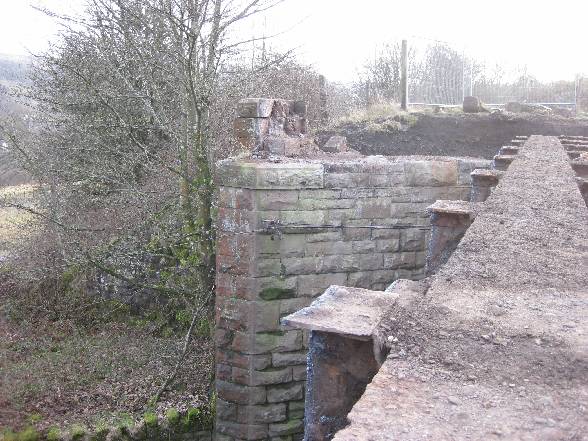
Looking
South, it is possible to see the southern abutment in all its glory. The path that once supported the PBR is now
gone, the remainder on the right supported the cycletrack. The top of the abutments will be taken off
soon, in order to allow them to be built a little higher, and with specialist
‘stools’ to support the new deck. The
increase in height will be realised using mass concrete, but cladding will be
sympathetic to the existing stones 7943 – |
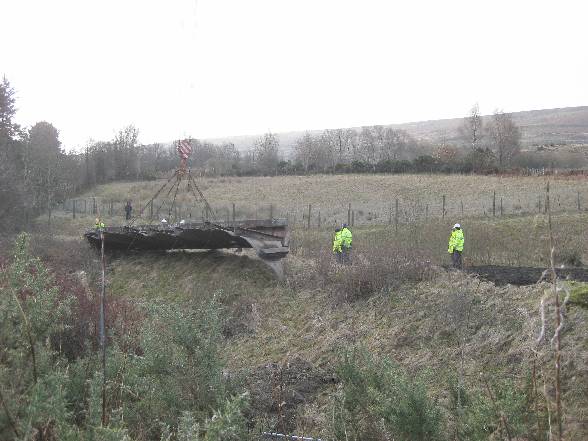
The first slice of the deck is landed
on the bank west of the vehicular access road to the original station. The tiny dark figure next to the fence is
our own ace photographer, Alistair Grieve. 7944 – |
|
And so on
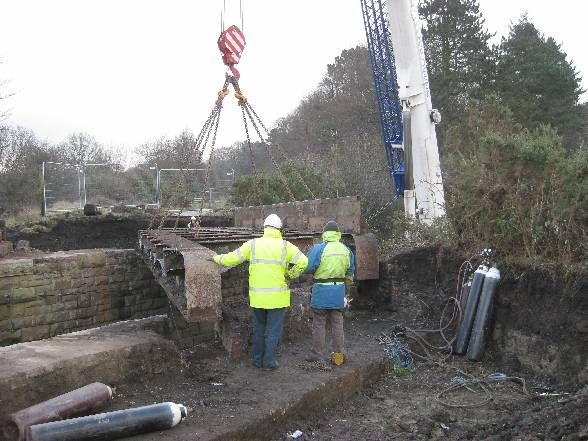
to the heavier, second slice. With the
chains tight, the banksman (with the blue top) is instructing the crane
driver by radio, but, like its predecessor, this second slice is also trying
to stay just where it was, and again, like its predecessor, a bit of wiggling
finally sets it free. 7947 – |
By 7954 – |
|
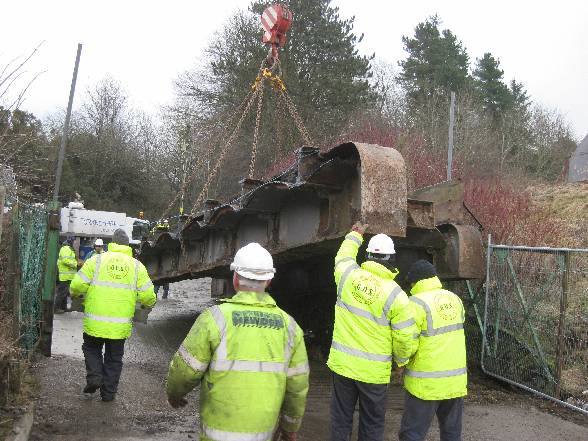
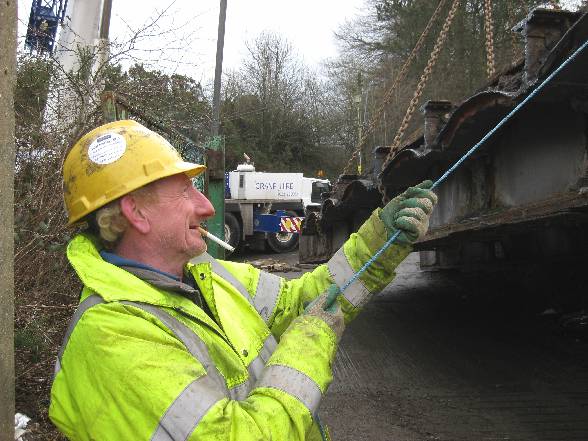
An important facet of lifting heavy
and difficult loads in the need to prevent the load spinning. A pair of men are posted at diametrically
opposed corners of the load with ropes, in order to control the situation. One of the 7956 – |
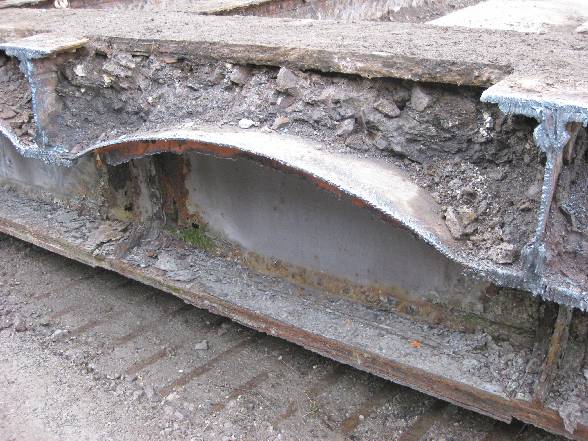
We can now see why the bridge was
much heavier than that estimated, firstly the weight of the jack arches was
ignored, secondly there is a great deal of impacted ballast rammed in under
the flange of the longitudinal, and perhaps, most unexpectedly are the extra
plates which cab be seen bolted the lower flange of the longitudinal. There is a suspicion that the upper flange
has seen similar treatment. 7957 – |
|
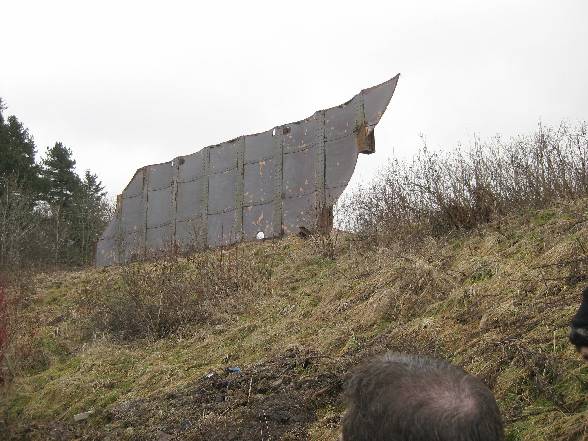
Blaenavon’s answer to the ‘Shard’ at 7959 – |
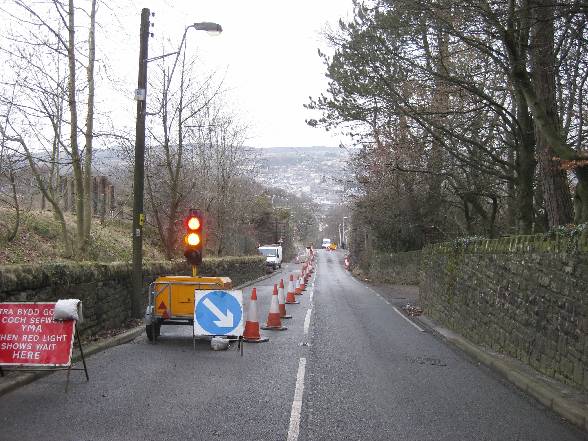
The ‘face’ of Blaenavon as you
approach it from Varteg looks rather as if it has its front teeth kicked
out. It was a familiar sight to
visitors to Blaenavon, and there is little doubt that they will be mildly
disconcerted when they come upon this vacant scene. 7967 – |
|
The second section of bridge had the
potential to be both a nuisance and an embarrassment, so no time was lost in
cutting up into furnace sized pieces ready to be taken away by scrap dealers
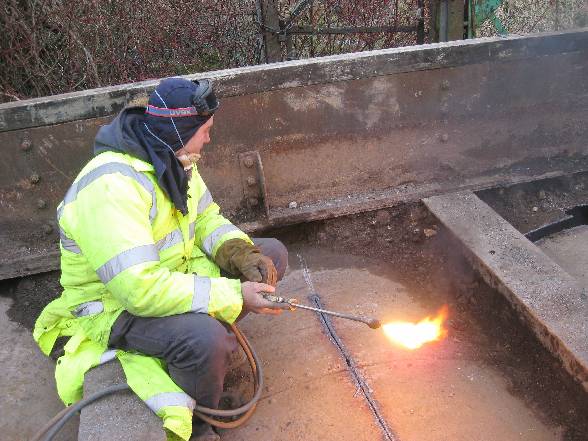
Sheedy of Newport either later in the day or first thing Monday morning. Here is one of the GOS Engineering welders
preparing to make another cut in the bridge section. 7969 – |
The bridge was installed around 1874,
so almost 140 years have elapsed since a scene similar to this was last
seen. It will be ten or eleven weeks
before the gap is bridged with not one, but two rather slender bridges – one
for the railway and the second for the cycletrack. 7971 – |
With ten or eleven weeks to go before the gap is
bridged, there is much to do.
Click
HERE to return to main Development page