DEVELOPMENT – PLATFORM AT BLAENAVON HIGH LEVEL STATION (Step
1.2.3) – Page 1
Platform
at Blaenavon (High Level) Station – Page 1 (uploaded 15 November 2008)
The bald statement from the specification
....and the refurbishment of the platform at
Blaenavon (High Level) station to minimum statutory standards.’’
...suggests that this refurbishment would be a
simple exercise, but this was far from the truth. Blaenavon is an historic town, and so, we
think, is its station (or rather one of its two stations). Despite the fact that virtually everything
had been destroyed, we were determined to save what little remained – and were
it didn’t remain we would attempt to rebuild something which, whilst not an
absolutely accurate reconstruction, would at least go some way to showing what
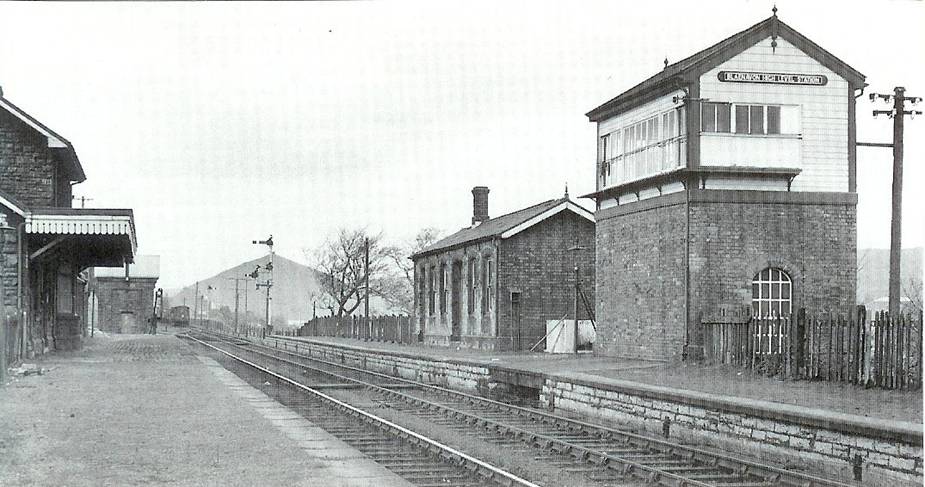
Blaenavon (High Level) might have looked like in its more active days. In its time Blaenavon (High Level) had up and
down platforms. The up platform
contained the main station buildings and was approached by a wide road
providing for vehicular access. Also on
the up side was a loco shed and a goods shed.
All, except some vestigial remains of the up platform were swept away,
post-war, when the area was occupied by a concrete works. The down platform was built with a stone
front wall and relatively narrow stone coping stones along its edge, behind the
copers the majority of the platform was of ash or macadam stone. The platform was approached from the main
road by a steep footpath and the two platforms were joined by a barrow
crossing. The platform contained a
sizeable waiting room, and a notably tall signal box. The waiting room was fronted by blue
diamond-cut setts rather than ash, whilst the area in front of the signal box
was clad with wooden planks overlaying a cavity through which the rods and
wires were channelled. These were the
kinds of features we wanted to preserve
|
Blaenavon
(High Level) station some time after nationalisation in 1948. The large
waiting room and tall signal box are obvious on the down platform. Less obvious is the uneven height of the platform
edge which reaches its greatest over the planked portion in front of the
signal box and falls on either side.
In the background a GWR pattern brake van pulls away from LMS pattern
signals. The station no longer served passengers after 1941, when it was
simply called ‘Blaenavon’. The suffix
came after the 1948 nationalisation to differentiate it from Blaenavon (Low
Level) – the other Blaenavon station, which was previously operated by the
GWR, and which was at the bottom of the hill.
It is thus possible to date this photo, judging from the name on the
signal box. (we are unable to attribute this photograph,
but acknowledge that the copyright resides elsewhere. We would be very happy
to make amends if called upon to so do) |
It became clear during discussions held in the early
part of 2007 that substantial funding was likely quite soon, and this soon
translated itself into enthusiasm for clearing, not only the track down to
Blaenavon (High Level) but the station itself.
It was no mean feat!


|
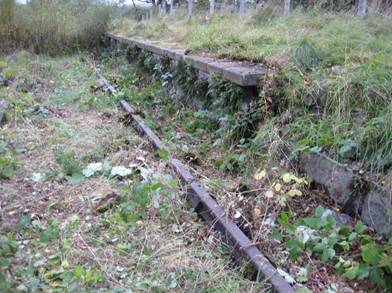
A view of
the south end of the platform showed it to be heavily overgrown, but
accessible, largely due to the fact that it was crossed at this point by an
informal access path to the cycleway... |
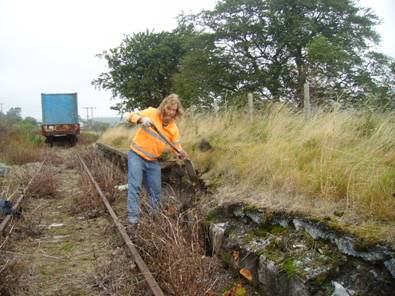
....unlike
the north end, which was completely impassable. Here volunteer Dave Perham emerges from the
undergrowth, having set upon the rampant willows and silver birch with a
chainsaw |
As
clearance to the north nears completion, almost the the only undisturbed part
of the platform (and certainly the longest undisturbed section) comes into
view. These photos were taken on 28
September 2007 |
Once we had cleared away the undergrowth the limited
remains of the platform, with its attractive stone front wall and stone coping stones
came into view. Unfortunately it also
came into the view of local house builders who were anxious to incorporate
local stone into their efforts, so that over 60 years since it was last used,
the majority of the cut course stone was stolen within a year or two of its
reconstruction. This caused some heart
searching. Since the project started in
April 2009, and funding had to be spent within a year, and since funds were limited,
reconstruction of the front wall with stone was impossible. In the end we settled on straightforward
dense concrete blocks laid broad face down.
We decided to make no effort to make a poor copy of the original, and
eschewed the use of ‘stick on stone’ or ‘Vera Duckworths’ as one of our
volunteers termed them. Another reason
for going this way was the very quick realisation that the original height of
the platform was far below what modern standards demand. There were also other
geometric and technical reasons that lead to this conclusion. Other early design decisions were that we
would (a) retain as much of the original stone wall and stone copers as
possible (b) rebuild the planked portion in front of the site of the signal box
(c) attempt to re-lay the blue daimond-cut setts in front of the waiting room
(d) re-lay the surface of the platform with high-grade asphalted tarmac rather
than ash (e) build characteristic buildings on the ‘footprints’ of the original
waiting room and signal box (e) instal reproduction lighting, whilst
acknowledging that the standard of lighting on the original platform was all
but non-existent
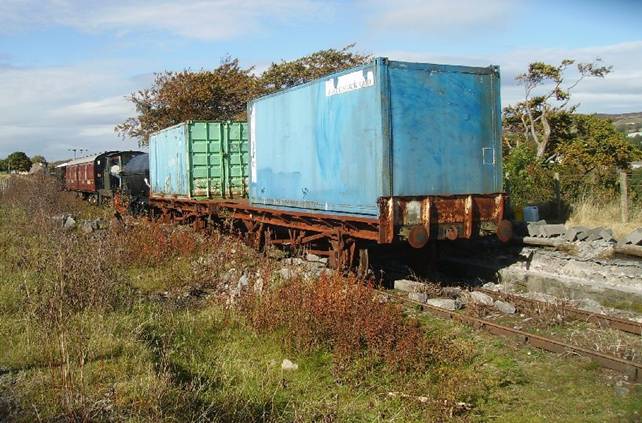
We soon became uncomfortably aware that the station
was 1.2 miles away from our yard at Furnace sidings. With neither power nor water, nor any
convenient road access, it was obvious that this would leave our volunteers
very isolated, and thus we needed to quickly assemble a vandal-proof ‘works
train’. Our first thoughts centred round
the use of a ‘Warflat’ or ‘Rectank’ This
was 42ft long flat bogie wagon specified by the Railways Executive Committee
(hence Rec...) for the carriage of battle tanks during World War Two. The idea was to drop a forty foot ISO
container onto it, and although space would be very tight at the ends when the
doors were opened, that was how we intended to proceed. Fate however offered us two twenty foot
containers at an acceptable price and these were taken up, since apart from the
Warflat, we had a pair of old ex-BR ex-Steel Works Plate wagons. These were 27ft long, and had lost their
sides (but not their ends) whilst in the steel industry. A little thought demonstrated that, coupled
together, with the inside end walls removed, a 14ft long work area could be
produced if the containers were pushed to the extreme ends. By coupling the wagons more or less
permanently together and by bridging the gap between them with a piece of steel
plate, loosely pinned to just one wagon, a total work space of about 17ft could
be realised – ideal!


|
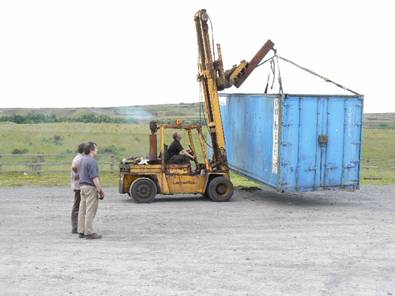
During June 2008, the second of the twenty foot ISO
containers was carried from the outside ‘arena’ into the yard, using the very
useful all-terrain ‘Manitou’. |
The Manitou was extended
to full stretch to get the container over he fence and into our ‘secure’ site |
With a useful few feet at the right hand end, the
container is loaded tight up against the end wall of the Plate wagon. In terms of width the container fitted with
a millimetere to spare between the shallow angles along the wagon sides (photos by Arthur Llewellyn) |
There was just one problem – what to call them! This was, without doubt the germ of a
engineering works train, and in true BR tradition we wanted to follow their
example and name them in the ‘fishkind’ series.
Trouble is BR seemed to have used every marine creature in Christiandom,
and we had to settle on the highly esoteric ‘Gurnard’ (for those who are
totally mystified, the Gunard is also called the Sea Robin). It wasn’t till a few months later that,
during a moment of idle thought, we
realised that ‘Flounder’ had not been used, and since the Plate wagons are
obviously flat, as is the Flounder, it seemed an ideal name – so Flounder it
is!
 ...
...
|
In July, a
month later, the works train is seen soon after its arrival at Blaenavon
(High Level) . It is seen here just
south of the ruined water tower, which we plan to rebuild in due course. |
Here it is
again from the diagonally opposite side.
Hardly pretty – and hardly
effective either! We soon realised
that we couldn’t mix mortar or concrete without water, and a tank wagon was
added to the ensemble shortly after. |
August and
Ian Longworth undertakes preparatory work on the wall, with typical vigour,
breaking away old fragments of stone and concrete to reveal the clean bottom
course of large foundation stones. |


|
This picture taken through the weeds towards the site of the signal box
is very much a ‘before’ comparison and will be used to compare with a later
image |
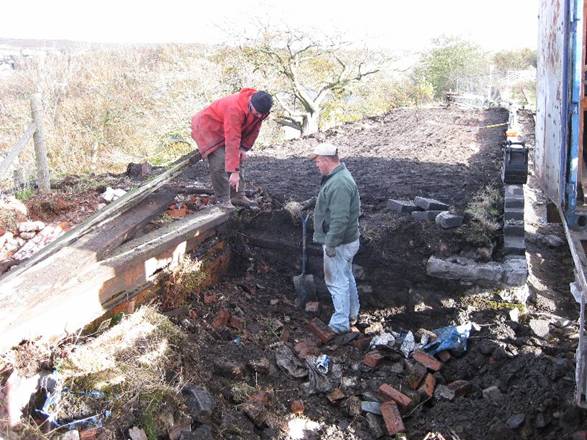
This
image, shown out of sequence and taken on 19 October 2008, and shows how the
return walls must be reconstructed in order to support the wooden joists
which will in turn support the wooden planks that form the platform. The area under the old joists must be
cleared to ground level. Charles James
is seen removing the bricks which were tipped into the hole provided by the
empty locking room. With luck we will
be able to expose the complete locking room down to the floor |
 .
.
|
The abandoned platform basks in the sun on a warm 19 July. The extent of dereliction is obvious. Another impediment to restoration is that
the original height of the platform is between 10 and 16 inches too low to
meet modern passenger standards |
The two Flounders precede the tank.
This is the ‘works train’. The
‘PWay train’, consisting of Loco 104 ‘Llanwern’ , a BR Mk1 full brake, a GWR
Pooley van and a Weltrol is used to move the works train. SInce this picture was taken the Pooley van
and Weltrol have changed places.(P1929- 9 Aug) |
Work at the station was
delayed by a flurry of special events on the railway, and finally by our Silver
Jubilee celebrations and it was not until 12 October that it was possible to establish
a suitably large and robust team to make meaningful inroads into the work on
the platform. However it had been
possible to undertake planning work in the interim, and one or two difficulties
had exposed themselves. In particular
the platform wall was anything but straight.
Although the track was sufficiently straight through the platform,
except at the extreme northern end, to use as a datum, in profile it dipped in
an uneven saucer profile through the platform by over 30mm.

|
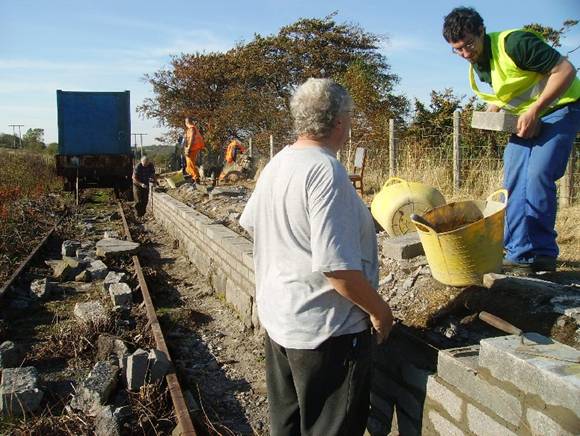
Sunday 12 October – and a rare day of Indian Summer – welcomes the
first real day of work by a full team on the platform wall. A record of 224 blocks were laid, onto the
foundation stone course, which had been cleared earlier in September and
October |
The day was enlivened by competition between Wayne Evans and Norman
Clymer as they race towards the middle of a course of blocks. This was only made possible by help from
assistants who kept the ‘layers’ constantly supplied with materials. Here Matthew Evans supplies his father with
concrete blocks. |
Whilst the track was straight enough – at least in
plan, the same could not be said about the platform. The part north of the signal box was not too
bad, but to the south there was a runout of up to 190mm towards the south end –
over little more than 30metres. It also
soon became abundantly clear that the course of ‘foundation’ stones was
anything but level. We always knew that
the number of concrete blocks required (each adding about 105mm when laid) to bring
the platform to the correct level would not be a whole number, so we had
planned to build a thick ‘adjustment ‘ course of mortar to serve that
purpose. The variability of the
foundation course however, forced us to lay a series of special shutters, each
screw adjustable, to adjust the shuttering to exactly the right thickness, and
to provide a level base onto which the coping stones could finally be laid.

|
Volunteers
from the PWay team unload concrete blocks, by hand, to waiting members of the
BHL gang. It is just about possible to
unload the blocks by the pallet, using the minidigger, but it is little if
any quicker (Sat 18
Oct) |
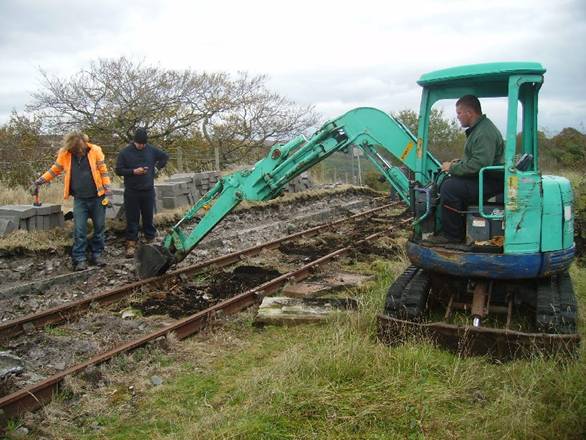
The PWay
team get first call on the minidigger so its availability at BHL is
limited. Here it is, idling away a few
moments by relieving the track (soon to be replaced) of its tree stumps. Dave Perham is on the minidigger with Ryan
Lark as his banksman. Ian Longworth,
takes a break from clearing out the course of foundation stones, whilst blocks
stand ready for laying into place (Sun
19 October) |

|
With the
undergrowth cleared it is possible to see the longest unbroken section of
complete wall and coping stones. Quite
apart from being far too low, there had been movement in the supporting
stonework, so it had to be dismantled and re-bedded. Oddly, the 4 ¾ milepost had been pulled
from the platform and hurled onto this pile of rubble, some distance away. |
Andy Parry and
Charles James carefully remove the blue paviors that were laid in front of
the erstwhile waiting room. The
majority were broken, but we will do everything possible to replace them (0002 25 Oct) |

|
Here we see
the stone wall being re-bedded, and the extra courses of blocks being added
in order to gain height wall (0005 26
Oct) |
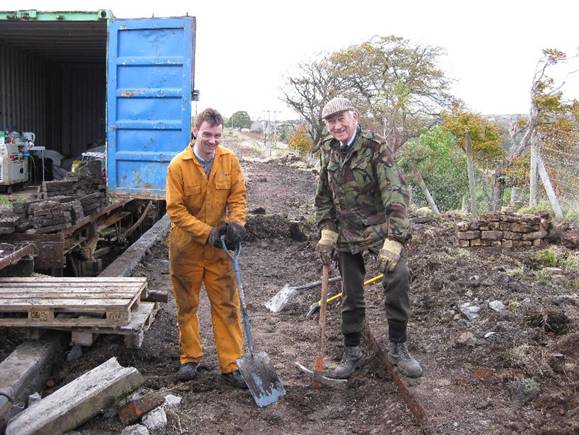
Norman
Clymer takes an interest as David Perham starts to clear the area in front of
the signal box. (0006 26 Oc)t |
Click
HERE to move on to Page 2
Click
HERE to return to main Development page