DEVELOPMENT – BUILDING AT BLAENAVON HIGH LEVEL STATION (Step
1.4.1)
Building
at Blaenavon (High Level) Station
(uploaded
In late 2008 it became clear as the grass and
undergrowth was removed from the platform surface at Blaenavon - High Level
station, that the bones of the original waiting room remained. Although the building had been demolished to
the level of the original platform, the foundation walls still remained. These walls were massively thick, and
although their geometry was complicated, with some picking about, a clear
footprint of the building emerged., and of overall dimensions about 13m x 4m.
After a final flurry, by 1 April 2009 the platform
itself had been completed, the funders came, inspected the work, were
satisfied, and went away again.. At the
time work on the bridges further up the line was in full swing, so that the
building team, and their works train was marooned at the station. Now the extension to Blaenavon - High Level (
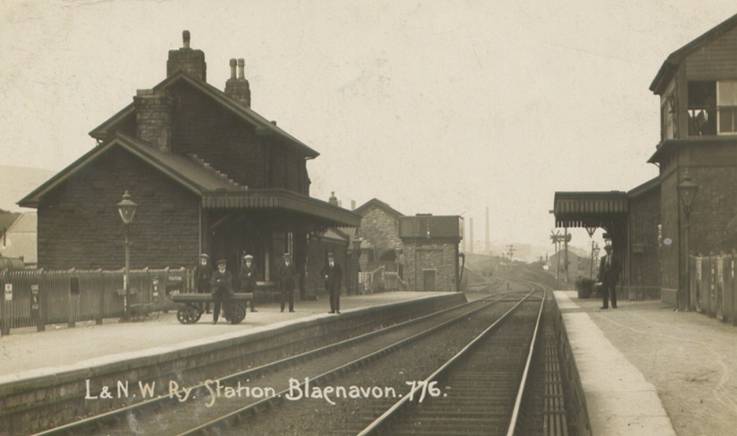
Here is Blaenavon (High Level) station in Edwardian
times. On the left is seen the main
station building, with a water tower at the far end of the platform. Behind that is the goods shed. There was also a loco shed here. On the right is the recently rebuilt platform
with its high signalbox in the foreground, behind that is the waiting room –
the building in question. It clearly has
a canopy.
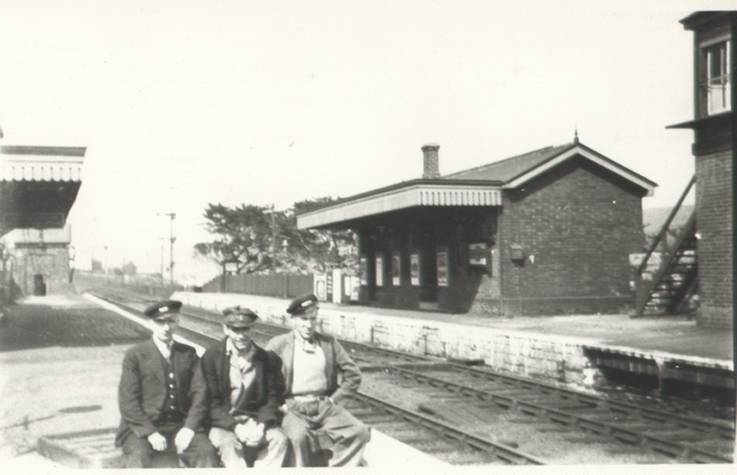
This happy and far more recent photo, probably taken
just after World War II, shows the canopy still in place. At the south (that is, the nearest) end of
the building we see a typical
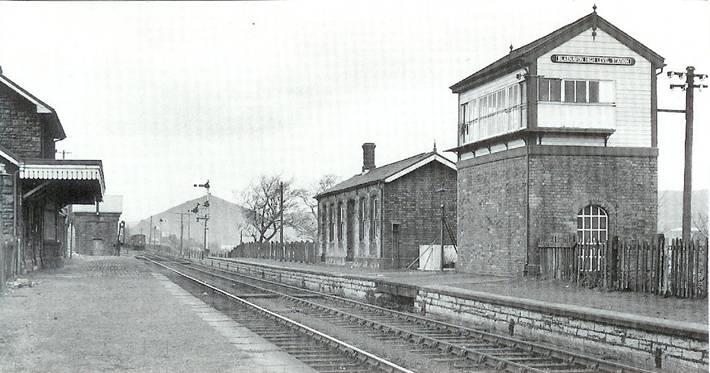
We make no apologies for
repeating the image found at the head of the ‘Platform –page 1’ page. The canopy has now been removed leaving seven
vestigial supports. Note the position
and number of windows. The previous
picture suggests that the Hawkseye obstructs the most southerly window. This is an, as yet, unresolved oddity.
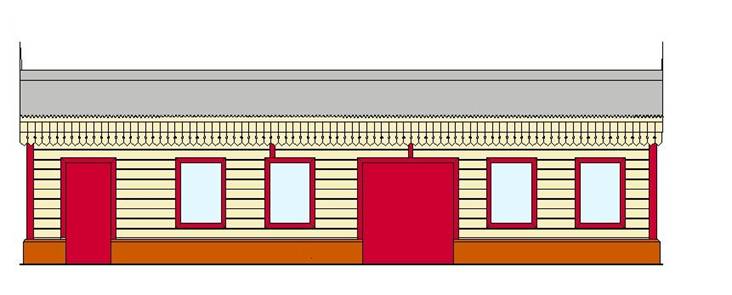
An impression of the
planned station building. Its primary
purpose is to show the relative positions of doors and windows. Unlike the original it is intended to provide
planked uppers, mounted on a bevel topped brick dwarf wall (hence the need to
recover certain bricks). Window details
are not shown, nor is a chimney shown.
The number of pillars is minimised in this sketch, though more are
likely in order to provide aesthetic balance
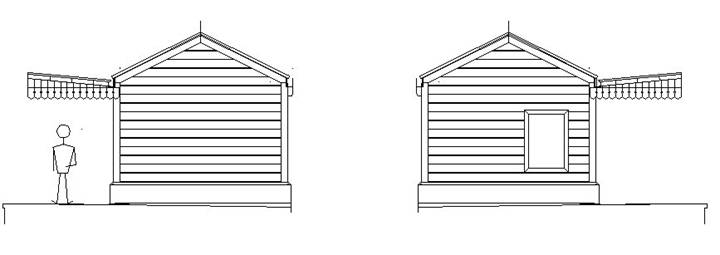
Here are the north and
south elevations showing the planked ends, and the position of the proposed
canopy. Details of the canopy are likely
to change. It is shown as 2m wide, but
may be extended to completely cover the width of the platform. The 1 in 80 slope of the platform towards the
rear, and this contrasts with the 1 in 20 slope towards the front edge that
existed originally. Railway Group
Standards insist on a rearward slope, and we were not inclined to argue for
Grandfather Rights with the Railway Inspectorate, since the upper surface is
‘new build’!
Since it had never been planned to tarmac over the
old station building, it was necessary to build up the walls a little, since
the new platform surface was over a foot higher than its predecessor. This was done in order to provide an ‘edge’
up to which the tarmac could be laid.
These walls were massively thick, and although their geometry was
complicated, with some picking about, a clear footprint of the building
emerged., and it soon became possible to accurately establish the overall
dimensions. What was perhaps more
interesting, was that the original building sat on a series of cellars, and,
during demolition, the walls had simply been pushed into them.
|
Christmas
has come and gone, but volunteers continue to labour, as the year draws to a
close. From the quagmire emerges the
base courses of brick which outline the building’s footprint. 1796 29 Dec 08 |
On a bitter
4 January, a forlorn sight, as the last train for at least six months leaves 1820 4 Jan 09 |


Although the demolition had, naturally enough,
caused essentially complete destruction, it also yielded a number of useable
bricks, including a number of specialised ‘bevel’ bricks that we particularly
wanted to retain. It was also soon
determined that, if we were aiming to re-construct something like the original
station it would make sense to preserve as many of the original features as was
reasonably possible. In particular, and
for reasons additional to simple preservation, we would try and preserve the cellars. Excavations started early on, but is became
increasing clear as the full extent and depth of the cellars emerged that
finding somewhere to put the arisings would become problematical. There was also the danger that trespassers
would be in danger of falling down the holes that were being created, so
barriers round the holes would be needed.
There seemed little point in constructing barriers for their own sake,
and so dwarf walls were constructed which would in turn form part of the
re-constructed building.
|
Heavy snow
and cold weather extended into early April, days before year one of the
contract drew to a close. During the
previous few months, additional courses of bricks had been laid in order to
delineate the extent of the tarmac covering. 2212 6 Apr 09 |
A fortnight
later, a hazy sun begins to warm things up, spirits rise, and on the trees
early leaf buds unfurl. Already the
front dwarf wall is up, as well as most of the south wall. Ultimately a brick skin will cover the
first five courses of blocks, rising from the existing brick courses 2334 19 Apr 09 |


|
Yet another
week passes and the leaves on the Silver Birch are almost fully out. Within the building the covering of weeds
and topsoil (and building materials) has been removed revealing a
‘brickfield’ containing incalculable numbers of bricks and tons of rubble, and of total volume about 60m3 all
of which must be removed and sorted by hand. 2356 26 Apr 09 |
At the
northern end of the building, excavation has been more rapid and volunteer
Charles is in danger of disappearing from view. The bottom of the cellar is about 7ft 6ins
(2.3m) below the level of the platform outside. Emerging into view is the foundation of a
fireplace, something we are keen to retain.
In the background the Warflat wagon which previously carried builders
materials now teeters under the weight of re-useable bricks – and there are
many more to come! 2359 26 Apr 09 |


|
The north
east corner of the building threw up some interesting but possibly insanitary
items during excavations. It had
clearly been a gentlemen’s lavatory in its time, and a stone channel and
rendered rear wall marked the position of a urinal, in the opposite corner
was the site of a quadrant shaped sink let into a corner. Behind a stud wall was found a WC pan. Overall the floor had been paved and in the
earth below a complex network of buried salt-glazed soil pipes was
uncovered. Some remaining internal
rendering showed obvious signs of being painted in 2393 2 May |
A ‘before
and after’ comparison shot which shows some subtle but important changes
since 19 April (see two images above).
The south dwarf wall is complete , the north wall has been started and
finished, and returns have been built into the back wall. But most importantly the fence along the
back wall has been removed. The posts
here put up major resistance to being removed, but finally yielded 2418 4 May 09 |


|
Each of two
‘proper’ cellars contained a single window.
Despite some fragments of
wooden jambs and cills remaining, the lintels had completely
disappeared and the walls above had collapsed. This caused some concern about how we would
construct the rear wall, but the chance discovery of some sections of
steel H-beam of just the right length
on the Furnace Sidings site allowed an effective bridge to be constructed 2420 4 May 09 |
Volunteer 2434 9 May 09 |


|
Another
‘before and after’ shot, this time for comparison with the image two frames
above. It shows courses of bricks
newly laid, with the 550mm dwarf wall on top The medium term plan is to
convert the space into a unisex disabled lavatory, however, at the back, some
of the space will be used to build a room in which an electrical generator
will be installed. 2422 4 May 09 |
This shot
shows the first course of blocks advancing along the steelwork that bridges
the remains of the two cellar windows.
In due course the windows will have some of their stones re-set and
will receive pre-stressed concrete lintels cast into place.. This will then allow the height of the
cellar walls to be made up to the underside of the steel beams 2437 9 May 09. |


|
The advance
continues around the back wall of the lavatory. On the right can be seen remaining courses
of bricks that make up the rear wall of the fireplace. In due course a solid floor will be
installed here. Would it perhaps be
more than happy co-incidence that the room most likely to be affected by
frost, was built immediately behind the fireplace? 2439 9 May 09 |
They say
‘Ne’er cast a clout till May is out’, and winter has its final fling as heavy
– and cold – rain engulfs the works.
Such weather brings an abrupt halt to block-laying. Along the front, recovered red bricks will
be used to encase the dwarf wall, provided they can be cleaned up
satisfactorily. These will be
topped-off with the blue bevel bricks also shown. 2454 16 May 09 |


|
As the
walls continue upwards it became advantageous to positively identify the
positions of the doors and windows, so temporary wooden frames were erected
to keep things straight and in good order 2462 16 May 09 |
The first
day of June brought gloriously hot and sunny- weather. In the heat and dust, working here was
reminiscent of the excavation of an Egyptian tomb - even if the archaeology
was not of the same standard! However,
together with the luxuriously green leaf-growth and clear, deep blue sky this
was a memorable day on which to work. This image also shows that most of the back wall having reached a height of
990mm. 2518 1 June 09 |


|
Still with
an incredibly blue sky and clear views of the Clochdy ridge, the block wall
climbs on upwards, constrained where necessary by its wooden frames. 2513 1 June 09 |
This is the
most southerly ‘cellar’. Whilst there
is no doubt that this cavity was covered with a suspended floor, we were
rather surprised to find broken fragments of glazed sanitaryware, a lead
water pipe and another salt-glazed earthenware soil pipe. Perhaps, in those happy non-PC days, this
was the Ladies’ Waiting Room – complete with a W.C. for their exclusive
use. By the time that several feet of
rubble had been removed it was clear that we had reached virgin soil, rather
than demolition rubble. There is no
obvious means of entry into this ‘non-cellar’, and, unlike the two proper
cellars, the walls had not been whitewashed.
Special measures are to be adopted here to ensure a free flow of air
under the floor in order to keep wet- and dry-rot under control. 2808 9 June 09 |


|
After a
brief exploratory dig earlier in the year, the floor of the first cellar is
reached a second time…In a two-hour outburst by two visiting volunteers from
the PWay crew, each very much younger than the elderly volunteers that work
at 2813 14 June 09 |
An
incorrect delivery of timber saw work delayed on the waiting room and, as a
result, effort was re-directed to improve the situation at the signal
box. The existing Heras
panels, temporarily installed to prevent trespassers falling into the hole
left by the locking room, are both unsightly and probably ineffective, and
certainly not suitable for semi-permanent use. There are no plans to construct a signal
box here at present. We had planned to
clear the locking room, and leave it open for viewing for a few years, with a
low safety wall round it. There is
however the possibility that two
signal boxes may be secured, one of which may be suitable for use at 2817 14
June 09 |


Progress
mid June 09 to mid-August 2009
|
In mid to late June, ‘wallplates’ were dropped into position. Fragments of old timber suggest that the
size was 2in x 4ins and this was repeated when the new timbers were
installed. Blue polythene sheet,
introduced to provide a damp-proof membrane obscures the timbers, but it is
easy to see that there is still a huge amount of material to lift out from the
cellars. However the deepening voids
made it inadvisable on safety grounds to continue building the main walls. 2836 20 June 09 |
Outside materials and rubble from the cellars continue to amass, making
access increasingly difficult. This
was at the end of June and the situation was to worsen considerably before
some clearance work began in mid-August .
The wooden frames have been removed from the windows and doors in
readiness for the fitting of the lintels. 2956 30 June 09 |


|
By early July the joist
had been dropped onto the bearing wallplate, to be stabilised and positioned
by noggins. Some joists in the centre
remained unfitted in order to provide working space for further excavation
work 2975 4
July 09 |
Here is an example of
what happens on a frustrating day. Too
wet to lay blocks, and still waiting for the flooring ply to arrive, a start
was made in reconstructing the chimney and fireplace. It will not be entirely ornamental since
the chimney will provide a useful support for the roof trusses. Local architectural salvage firms have a
bewildering variety of fabulously atmospheric fireplaces, and we are hoping
that there will be sufficient funds to purchase and fit one. 3039 19
July 07 |


|
The second cellar is just
about cleared. Volunteers Charles and
Russell peer triumphantly upwards from the depths 0027 2
Aug 09 |
A few days later, much of
the temporary flooring ply had been placed in position, and one or two sheets
screwed down. 0055 6
Aug 09 |


|
Volunteers Albert and
Charles pose in cellar 2 (the more southerly of the pair). Now that the temporary flooring has been
fitted in the is area, it has become a very dark place, lit only by a small
east-facing window and the flash from the camera. Charles would be horrified to be seen in
patterned trousers – this is an aliasing effect and is, mercifully, not real! 0060 9
Aug 09 |
A view from cellar 2
northwards into cellar 1 shows the only realistic escape is the ladder beside
the base of the fireplace. The walls
either side of the door will be built up and repaired in due course in order
to provide additional support for the floor. 0064 9
Aug 09 |


|
The biggest and longest
lintel – a pair of 6in x 4in steel reinforced concrete beams, span the space
where the main, double, doors will be fitted.
0070 9
Aug 09 |
With more of the
temporary floor in position, it has been possible to return safely to
building of the rear wall which is progressing well on up to its full height 0091 16
Aug 09 |


Progress mid-August to end of September (uploaded
With work at a bit of a
lull, whilst we wait for materials to come in, it seemed an appropriate time to
make a brief report. Once again, the
images will tell most of the story
|
With the works train pushed south beyond the platform, in aid of the
photocharter on Monday 14 September, the full extent of the platform became
apparent as this image shows. With the
blockwork essentially complete up to the level of the canopy cantilevers,the
southern 2/3 or so of the platform, and the size and position of the station
building can be seen. Although some
bags of rubble have been placed close to the site of the proposed platform 2,
where they will be used as infill, there is still a large quantity of rubble
and reclaimed bricks on the platform, that will need moving before much
further progress is made. 0268 11 Sep 09 |
With the works train clear, it was possible to see the front elevation
of the building. The purpose of this
image was essentially analytical, showing, as it does, from the left, the
door to the disabled unisex lavatory, two windows belonging to the staff room
/ ticket office, double doors to the waiting room, and the two windows to the
waiting room. This dour and forbidding
countenance is not representative of the final product, which will be clad
with horizontal shiplap, with a brick plinth about 21ins. high capped with
blue bevel bricks. Inside the
building, the cellars are covered with a ¾ inch temporary plywood floor
supported at 12 inch centres on 12 x 8 inch joists 0269 11
Sep 09 |


|
On Saturday 12 September the final blocks in the 0282 13 Aug 09 |
With the photocharter due on Monday 14 September a portion of the
preceding weekend was given to constructing this temporary running in board
in typical thirties ‘Hawkseye’ style. Although
built in relatively lightweight style but nevertheless quite substantially, within
a week some of the local youngsters had crawled from their sewers, loosened
the entire sign, stolen the board, and broken one of the posts – a depressing
experience indeed. 0292 13
Aug 09 |


The building now lies at a
important situation, with plans to get the roof on well before the winter and
dark nights come along. However the
situation is far from straightforward.
The steelwork for the seven canopy cantilever beams arrived on 21
September and the 33 roof trusses, wallplate timbers and fixtures &
fittings are due to arrive on Saturday 26 September – two weeks late. In terms of the construction, before the roof
trusses go on the chimney must be built to the full height since this will
pierce the roof, and modifications to one or two roof trusses will be
needed. In order to carry the full
weight of the slates the back wall must be strengthened. This will need three
ferro-concrete lintels to be placed above each of the two cellar windows, and
all the related stonework re-cemented into place. In turn this will need that a roofer has been
identified. Fortunately we have been
able to identify an experienced roofer, who has seen the job, and put forward
some realistic plans with realsistic prices.
Despite the desire to see
the roof on before the winter sets in, the heavyweight creosoted timbers for
the LNWR style fence have arrived, and whilst there is no statutory need for a
station building, there is a requirement for a fence – at least on the half of
the platform south of te building. There
will also be some excavation work needed to lay an underground cable needed to
supply single-phase electricity to the station building, but all these tales
belong to another section.
Click HERE to return to
main Development page